Why That Fast Food Burger Should Make Every Homesteader Furious
Step back for a second and picture this. You unwrap a burger, take a bite, and everything feels normal—until you realize that same piece of “food” could sit on your counter for over a decade and never rot, never mold, never even smell.
That’s not a rumor. That’s not exaggeration. That’s real. And once that sinks in, you can’t unsee it—because the question isn’t just what are you eating?… it’s what kind of system produces something that even bacteria won’t touch—and then calls it lunch
Alright, if you’ve ever raised your own hogs, watched a little pig grow into a full animal on pasture and scraps, or stood over a grinder on a hot August afternoon turning your own beef into burger… this one’s going to hit a nerve. Because out there, you’re doing it the hard way—the honest way—and you actually know your food from start to finish.
Meanwhile, a billion-dollar system has been feeding people something that barely qualifies as food at all. They’ve engineered it, refined it, and counted on you not asking too many questions. And now, slowly, the cracks are starting to show.
A Lawsuit, a Fake Rib, and a Bigger Problem
So let’s start here. There’s a lawsuit putting McDonald’s under pressure over the McRib, claiming it misleads people into thinking they’re eating real rib meat.
Now, if you’ve ever broken down a hog, you already know how off that is. You know what ribs look like, how they cook, how they pull apart—and that molded patty in a McRib box isn’t it. It’s pressed scraps, shaped to mimic something real.
That’s not a cut of meat.
That’s a costume.
And strangely enough… it’s not even the worst part.
The Burger That Wouldn’t Rot
Now here’s where things take a turn. A McDonald’s burger once sat on a shelf for 14 years without molding, rotting, or even smelling off.
Think about that for a second. Real meat starts breaking down almost immediately, because that’s what living food does—it participates in the natural cycle.
But this didn’t.
If bacteria won’t touch it… what exactly happens when you eat it?
One Patty, One Hundred Animals
Now peel things back another layer. That burger patty isn’t coming from one cow—it can be a blend from over 100 different animals, processed and mixed into one uniform product.
On a homestead, you can trace your meat back to a single animal, a single pasture, a single moment in time. You know what it ate, how it lived, and how it was handled.
That’s food integrity.
But in an industrial system, that traceability disappears. It gets replaced by scale—and scale replaces accountability.
And here’s the real issue. If even one animal in that mix carries contamination, it doesn’t stay contained—it spreads across everything.
That’s not butchering.
That’s blending risk.
Beef That Needs Help Tasting Like Beef
Now here’s something most people never consider. That “beefy” taste you expect isn’t entirely coming from the beef itself.
There’s added “beef flavoring” in the patty—compounds derived from things like wheat and milk. In other words, the flavor has to be engineered back in.
Think about that.
Imagine slow-smoking a pork shoulder all day, then spraying it with artificial pork flavor before serving it. It sounds absurd, but that’s essentially what’s happening—just hidden behind better branding.
From Fryer Oil to Industrial Chemistry
Then there’s the cooking process. McDonald’s uses an anti-foaming agent called dimethylpolysiloxane in its fryer oil to keep things running smoothly.
It’s also used in industrial and silicone-based applications.
Now compare that to how things used to be done. Lard, rendered from a pig, straight into the pan—one ingredient, no surprises.
Simple.
Traceable.
Real.
Salt, Storage, and Shelf Life
Next, consider the sodium load. A single Quarter Pounder delivers over 1,000 milligrams of salt—nearly half your daily intake in one meal.
Your body doesn’t shrug that off. Your kidneys go to work immediately, and over time, that repeated strain adds up.
And meanwhile, that “fresh” burger may have been processed, frozen, shipped, and stored for months before it ever hit the grill. By the time it reaches your tray, it’s been through a long chain of handling that has nothing to do with freshness.
No pasture.
No immediacy.
No connection.
The Bun: Where It Really Falls Apart
You’d think the bread would be the safest part. Flour, water, yeast, salt—that’s how it’s always been done.
But not here.
McDonald’s buns can contain around 40 ingredients, including high fructose corn syrup. That’s not there for tradition—it’s there to enhance craving and shelf life.
On a homestead, bread is straightforward. Maybe you grind your grain, maybe you keep a sourdough starter going, but you know exactly what’s in every loaf.
No mystery.
No manipulation.
When Food Starts Looking Like Construction Material
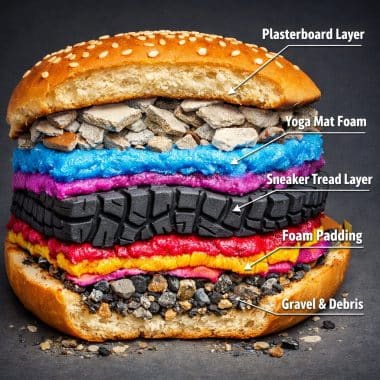
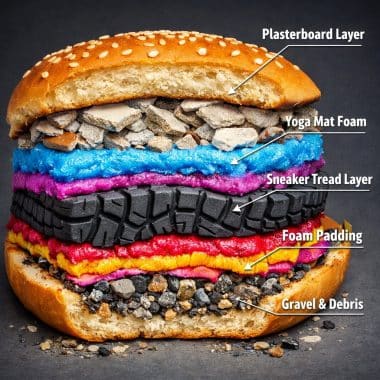
Then you run into ingredients like calcium sulfate. It’s used in the bun—and also in drywall and plaster.
Now, yes, it’s considered safe in small amounts. But that’s not really the point.
The real question is this: why does bread need structural additives in the first place?
Because it’s no longer about nourishment. It’s about stability, texture, and appearance.
The Ingredients That Quietly Disappeared
Until 2014, McDonald’s also used azodicarbonamide in its buns. It made the bread lighter and more shelf-stable.
It’s also used in things like rubber and foam products.
That ingredient didn’t disappear because the company had a sudden change of heart. It disappeared because people noticed—and pushed back hard enough to force change.
That matters.
Banned Elsewhere, Still Allowed Here
Then there’s potassium bromate, a compound linked to potential health risks. Enough countries have banned it—Europe, Canada, China—that you’d think it would be gone everywhere.
But in the United States, it’s still legal. Still used. Still quietly present in certain commercial breads.
And most people never think twice about it.
Engineered for the Camera, Not Your Body
Here’s the detail that really pulls everything together. McDonald’s tests its buns for compression, making sure they hold their shape perfectly when squeezed.
Why?
Not for taste. Not for nutrition. Not for digestion.
For appearance.
Because the burger has to look good in a photo.
What Homesteaders Already Know
Now step back for a minute. If you grow even a small portion of your own food, you already understand something most people have forgotten.
Real food is simple, and it behaves like something alive.
It spoils.
It changes.
It returns to the soil.
That’s not a flaw.
That’s the design.
Take Back Your Plate
And here’s the part that matters most. You don’t need a full homestead to step away from this system—you just need to start somewhere.
A small garden. A connection to a local farmer. A loaf of bread you baked yourself.
That’s how it begins.
Because every time you choose real food—food you can trace, food you understand—you’re stepping out of a system that treats meals like products and people like consumers.
And out here, even on a small patch of ground…
That choice is still yours.
Leave a Reply