Last Updated: November 14, 2026
Latest status: The FAA lifted the nationwide ground stop on Friday evening, and flights were allowed to depart again. Delays and cancellations continued afterward, and airlines warned they could run into the weekend. Check your flight with your airline, and see the FAA’s air traffic status page for current airport delays.
For hours on Friday, nobody’s flight was leaving. On the afternoon of November 13, the FAA ordered a nationwide ground stop that kept departing flights on the ground at airports across the country.
Planes already in the air kept flying to where they were headed. Everything waiting at a gate stayed put.
If someone you love got stuck at an airport, or you’re wondering how you’d get home if this hit you, read the section called “Your Only Way Out Can’t Be One Way Out.” That’s where my answer is.
At a Glance: FAA Ground Stop
- The FAA ground stop halted departing flights nationwide on Friday, November 13. Planes already flying were allowed to land. The stop was lifted that evening.
- Homeland Security called it a telecommunications outage and said there was no indication of an attack. Transportation Secretary Sean Duffy blamed overloaded routers in an old air traffic control system.
- Nearly 7,000 flights were delayed or canceled, according to FlightAware, and airlines offered rebooking waivers.
- Your backup plan is a road-ready car, 2 routes home, a paper map and 72 hours of supplies.
What Happened on Friday
The order went out at 12:54 p.m. Pacific, which is 3:54 p.m. Eastern. It kept planes from taking off at every U.S. airport, while flights already in the air continued on.
About 20 minutes later, the government said a communication issue had hit every regional air traffic center. Those are the centers that track planes between airports. Homeland Security later called it a telecommunications outage, and the Transportation Secretary said routers in an old system became overloaded with data.
Some flights started moving again in pieces. Pacific-bound flights out of San Francisco resumed about 2 hours after the halt, and inbound international flights were handled case by case.
Earlier reports said the stop for everything else would run until at least 8:30 p.m. Pacific. By 8:30 p.m. Eastern, the FAA said departures had resumed, but the backlog stayed. If you’re flying this weekend, check your airline before you leave for the airport. Delta waived change fees for Friday and Saturday.
What the FAA ground stop means if you’re traveling this weekend
Expect delays to linger even after planes start moving again. Planes and crews end up in the wrong cities, and airlines need time to put them back where they belong.
If your flight is canceled, ask your airline about rebooking before you leave the gate area. Several airlines posted rebooking waivers, so ask before you pay a change fee. Keep your phone charged, and write your confirmation number on paper in case your battery dies.
If you’re picking someone up, stay home until they’ve confirmed a new departure time. That keeps you off crowded airport roads, and it keeps your own car fueled and ready if plans change again.
How rare is this?
Very. The last nationwide ground stop came in January 2023, when a pilot alert system went down. Before that, you have to go back to the days after September 11, 2001.
That’s 2 in the 25 years since 2001. Friday made 3.
The Questions Nobody Has Answered Yet
My read: what we’ve heard so far is a description, not an explanation. “Communications outage” tells you what broke. It doesn’t tell you why it broke, or why the backups didn’t carry the load.
So far, officials have said they aren’t ruling anything out, but they’ve seen no sign of a deliberate attack. That same afternoon, there were separate reports of communication and internet trouble in other parts of the country. Nobody has said whether the two are connected.
Asking what failed is fair. Guessing isn’t. Nobody has shown this was a hack, so we won’t tell you it was.
Here’s who was in the room, going by what officials said in public. The FAA, which is part of the Department of Transportation, ran the response. Homeland Security, which assesses threats, said it saw no indication of an attack. That fits the Transportation Secretary’s explanation of an old system overloaded.
That’s reassuring about the cause. It’s not reassuring about your plans. Agencies can coordinate the system, but none of them can put your plane in the air while it’s down.
Here’s the part that matters for your family, whatever the cause turns out to be. One shared system broke, and flights stopped in every state at once.
The FAA ground stop shows you how much of daily life runs through systems you’ll never see. Your phone, your card reader and your GPS all lean on networks like that. When one of them goes down, you find out fast which of your plans had a backup.
Your Only Way Out Can’t Be One Way Out
Most people have one way home. They book the flight, and that’s the plan.
A better approach is a 4-layer plan, sometimes called PACE: Primary, Alternate, Contingency and Emergency. Each layer is a different way to reach the same place, so losing one doesn’t strand you.
| Layer | Getting home from 800 miles away |
|---|---|
| Primary | Your flight |
| Alternate | Your own car or a rental |
| Contingency | A bus or a train |
| Emergency | Someone from home drives out and meets you halfway |
Now, there’s a fair argument for not moving at all. If you’re safe at an airport hotel and the delay is short, waiting a day is often smarter than a long drive on no sleep.
At highway speed, 500 miles is roughly 8 hours behind the wheel before you add a single stop. That’s a real cost, and it gets more dangerous when you’re tired.
So here’s where I land. Wait if you’re safe and the delay looks short. Switch to your alternate if someone at home needs you, or if the delay keeps growing.
Talk it through with your family now, while nobody is stuck anywhere. Everyone should know the rule before the phone rings.
Pick your switch point before you need it. “If my flight isn’t rebooked by tomorrow noon, I’m driving” is a plan. “Let’s see what happens” isn’t.
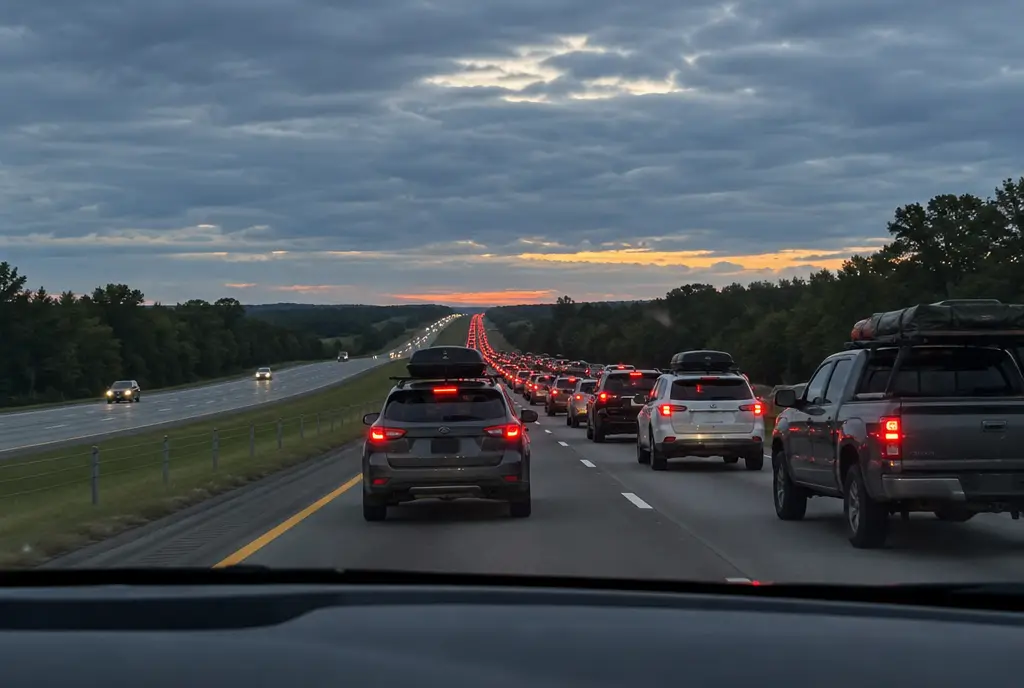
Illustration for planning purposes. This is not footage from Friday’s ground stop.
The same thinking applies at home. If a crisis hits and you have to leave, the question is the same. Do you have more than one way out, and do you know when to use it?
4 Checks Before You Need Them
You can’t fix any of this on the day it happens. Here’s what to check this weekend.
Is your car ready for a 500-mile drive?
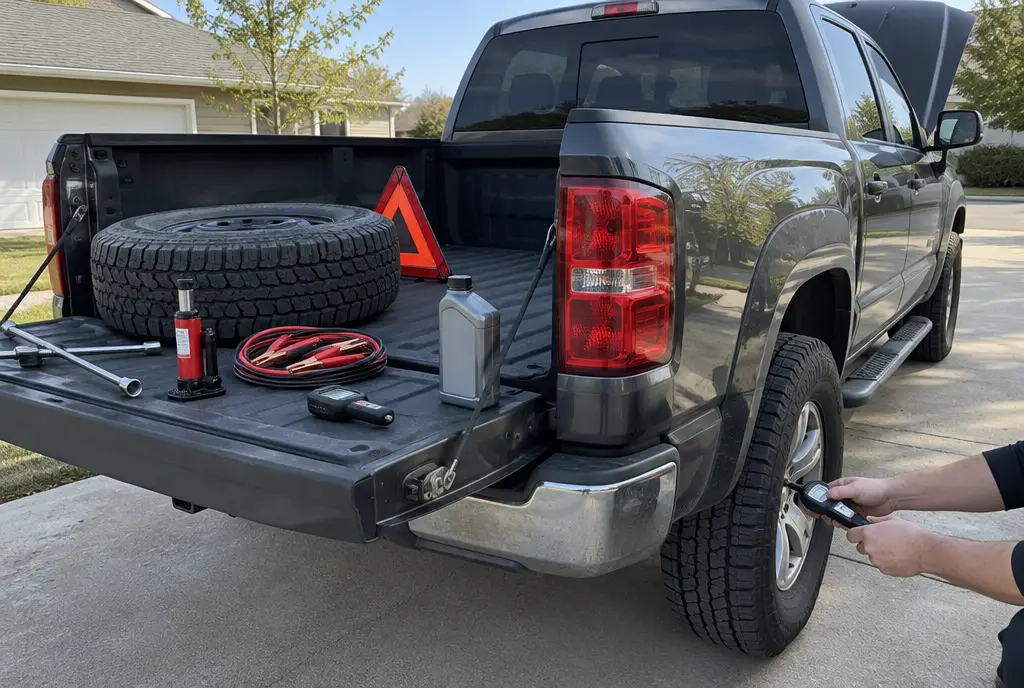
Your car is your alternate, so treat it like one. Check tire pressure and tread, and look at the spare too. A flat spare is no spare.
Check the oil, the coolant and the wiper fluid. If the battery is slow to crank on cold mornings, have it tested before winter, not after it dies.
Keep the tank at least half full. When everyone needs gas at once, the lines get long fast. Our vehicle bugout kit checklist covers what belongs in the trunk.
Do you know 2 ways home?
Most of us know one route, and it’s the one the phone picks. When everyone leaves at once, that route fills up first.
Pick a second route that stays off the main interstate for as long as it can. Drive part of it once, so it isn’t new to you on a bad day.
Could you find your way without your phone?
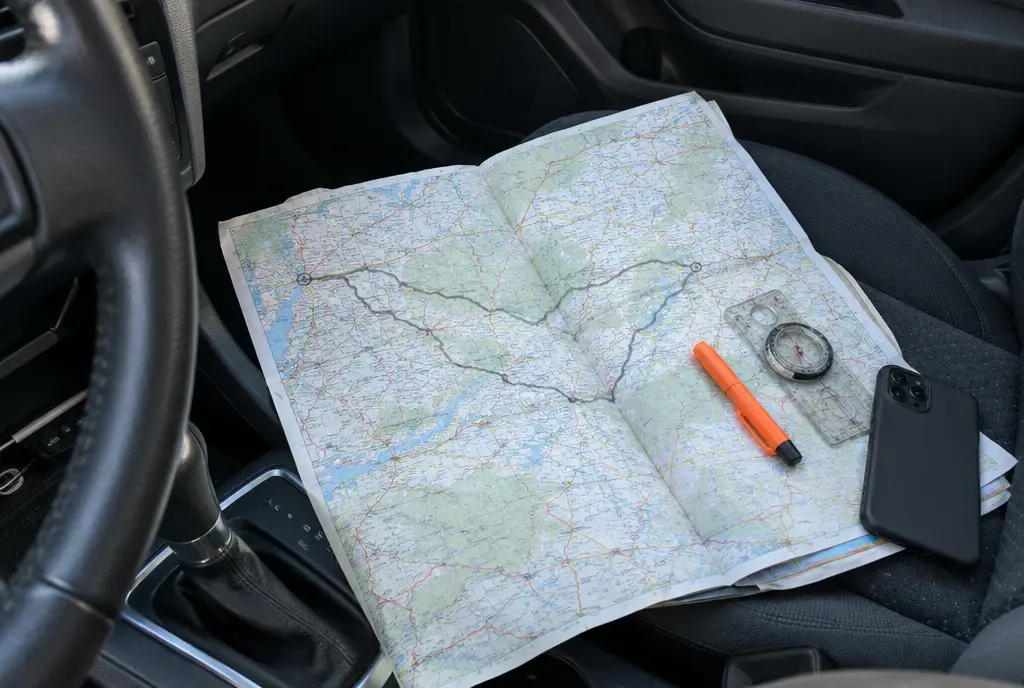
Offline maps help, but they only guide you if your whole route sits inside the area you downloaded. Download your region tonight.
Then put a paper road atlas in the car. It needs no signal and no battery. Trace your 2 routes on it in pencil, so you’re not learning the map while you drive.
A compass is cheap. It only helps if you’ve used one before, so practice with it once on a drive you already know.
Could you last 72 hours away from home?
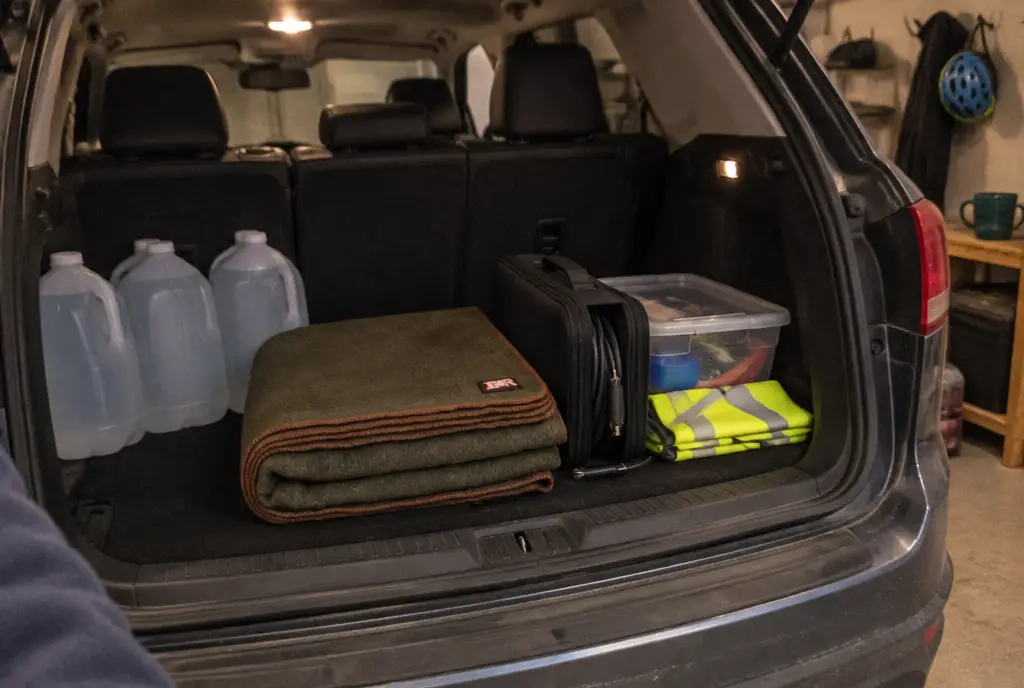
Think about where your stuff is. Most people’s supplies sit in a closet at home, not in the car they’d be driving.
The trunk above shows what a car kit can look like. Our 35-item vehicle bugout kit list breaks it down item by item.
Plan on 1 gallon of water per person per day, so 3 gallons each for 72 hours. Carry 3 days of any medications you take, a phone charger with a power bank, warm layers and small bills.
Our car emergency kit guide is a good starting list. If you might have to walk, each adult needs a grab bag light enough to carry 3 miles. Test that on a weekend.
Last, pick one out-of-town contact everyone in the family checks in with. Write the number on paper and keep it in every car and every bag.
Common Mistakes
- Treating one airline as your whole travel plan. A flight is one layer. If it’s your only layer, a single outage strands you.
- Waiting with no deadline. Hoping it clears up isn’t a decision. Set the time you’ll switch plans, and stick to it.
- Driving through the night to beat the crowd. A tired driver is a bigger risk than a late arrival. Stop and sleep.
- Keeping the kit at home. Supplies in a hall closet don’t help you at a rest stop 600 miles away.
- Trusting the blue line on your phone. When signal drops or the route jams, you need a map you’ve already marked.
- Filling the silence with rumors. Early stories about the FAA ground stop changed by the hour. Act on what’s confirmed and keep checking.
Frequently asked questions
Officials said a communications outage hit the regional centers that guide planes between airports. Homeland Security called it a telecommunications outage, and Transportation Secretary Sean Duffy blamed overloaded routers in an old system. Officials hadn’t explained why the backups didn’t keep things running.
No. The order kept departing flights on the ground. Planes already flying continued to their destinations, and inbound international flights were handled case by case.
No. The FAA said departures had resumed by 8:30 p.m. Eastern on Friday, after it lifted the nationwide ground stop. Delays and cancellations can linger as planes and crews get back in place. Check your flight with your airline before you leave for the airport.
Nobody has shown that. Homeland Security said there was no indication of a nefarious attack, and officials pointed to a telecommunications outage and overloaded routers. Treat any claim of a hack as unconfirmed until there’s evidence.
Keep your phone charged and check your airline for rebooking. Set a deadline for switching plans, such as driving or meeting family halfway. If you’re safe and the delay looks short, waiting is usually the better choice.
Do One Thing Today
Thanksgiving is on November 26, less than 2 weeks away. If you have travel booked, write down your switch point now.
Tonight, pick the place you’d most need to reach by car, then mark 2 different routes there on a paper map. Put that map in your glove box before you go to bed.