A winter field test for handheld radio range
The power has been out since yesterday. Cell service has gone from unreliable to useless. Someone leaves to check on a relative, and you agree to keep in touch by handheld radio. You hear them clearly from the driveway. Ten minutes later, they call from the far side of a hill, and you hear nothing.
Advertised handheld radio range can’t tell you whether that call will get through. What matters is whether your two radios can pass a clear message between the places you’ll actually be. You can answer that with a partner, a paper map and an afternoon on roads you already travel.
Field test steps
Start with the calls you’d need to make
Mark your home base and three to five places where a call would matter during a prolonged outage. That could be a neighbour’s house where you’d check on someone, a junction where a driver needs to report a blocked road, or a relative’s driveway where you’d confirm everyone arrived.
Write down where each person would actually stand or sit. If someone at home normally listens from the kitchen, start there. If the driver would call from inside a parked vehicle, start with the windows up. A good result from the front porch tells you what works from the porch. You still need to know whether someone in the kitchen will hear the call.
Before leaving, agree on the test route, the planned stops and a return time. Bring your normal means of contact for the exercise. Make every vehicle test from a safe, legal place to park.
|
||||||
| Check compatibility with your firearm before ordering. Affiliate link: CPN may earn a commission. |

Prove the radios work before you leave
Put fresh or fully charged batteries in both radios. Match the channel and turn off any setting labelled privacy code, interference eliminator or quiet code for the first test. These settings filter which calls you hear. They don’t make a conversation private, and a mismatch can make a perfectly good signal seem like a dead spot. Confirm both radios can send and receive while you’re still close enough to walk over and compare settings.
For a licence-exempt test, use handhelds certified for Canadian FRS or GMRS use. If you’re testing with programmable Baofeng amateur radios, make sure each operator who will transmit holds the appropriate Canadian amateur radio qualification and uses authorized frequencies and equipment. Check the exact model and its intended radio service before buying. ISED publishes the Canadian FRS and GMRS equipment requirements in Annex E of RSS-210 and explains how to earn your amateur radio qualification.
Thinking about getting your ham radio certificate? The Canadian Basic Amateur Radio Course for Preppers at PrepperRadio.ca walks you through the material in structured online lessons and quizzes to help you prepare for the Basic Qualification exam.
Test handheld radio range in both directions
At each stop, listen for other traffic, then press the push-to-talk button, pause briefly and send a short test message. Include two details the listener hasn’t been told to expect. For example:
“Driveway test. Pickup at four twenty. Bring the blue bag.”
To score handheld radio range at each stop, have the person at home read both details back. Then they send two different details for the person in the vehicle to repeat. Log the result for each direction. A burst of static, a clipped call sign or a voice you can hear without making out the words won’t tell you where to go or when to be there.
| Mark | What happened | How to use the result |
|---|---|---|
| Clear | Both people repeated both details correctly on the first try. | Candidate for a regular check-in point. |
| Marginal | Someone needed a repeat or had to change position. | Record what helped and retest before relying on it. |
| Failed | A complete message didn’t get through in one or both directions. | Mark a reachable fallback stop or use another contact method. |
Record the location, the channel, whether each operator was indoors or in a vehicle, and what each person heard. Use the same settings at every stop so you can compare handheld radio range across the route. If a call fails, change one thing at a time. Step out of the parked vehicle and try again. Then, if needed, have the person at home move from the kitchen to the porch. Now you know which change made the difference.
|
||||||
| Affiliate link: CPN may earn a commission when you purchase through this link. |

Map the route by check-in stops
A kilometre of open ground and a kilometre through a low road cut are different radio paths. Hills, buildings and other obstructions can change handheld coverage enough that a farther stop works while a closer one fails. Terrain and antenna height both affect handheld radio range and which parts of the route you can reach from home.
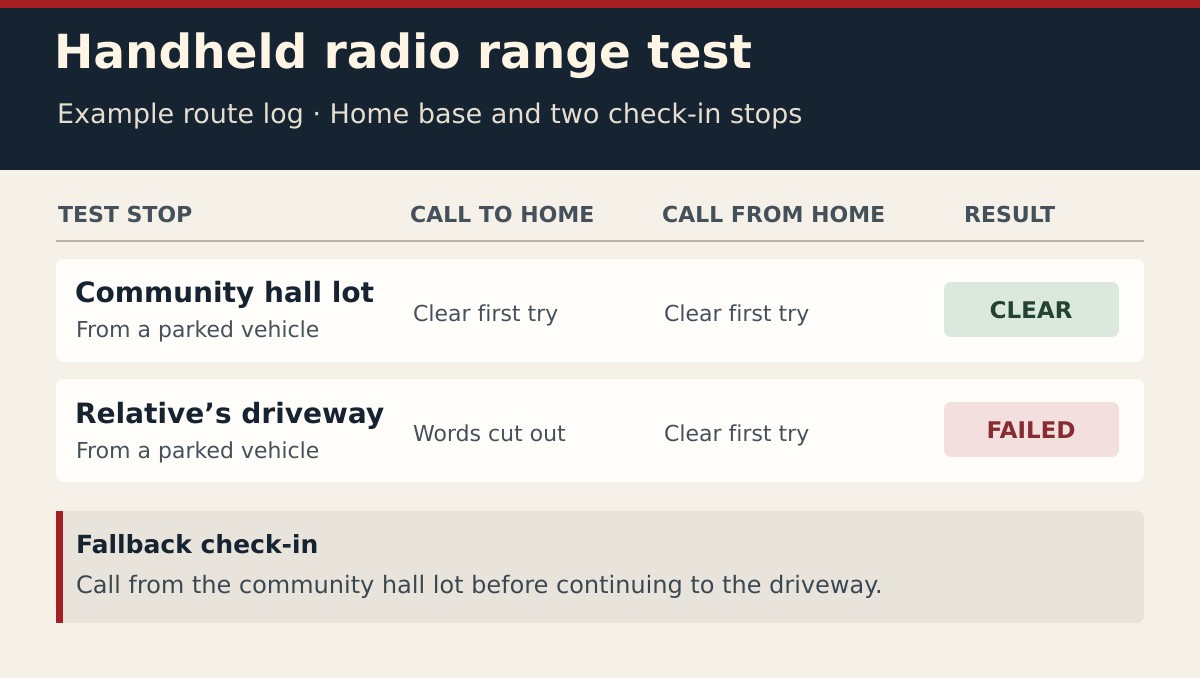
Suppose you reach home clearly from the community hall parking lot. The call from your relative’s driveway comes through broken. You repeat the test from outside the vehicle and still can’t pass the whole message. Your map now has a useful instruction: call from the hall lot before continuing to the driveway. If the driver needs to speak to home again, everyone knows where the next workable call is likely to come from.
Check handheld radio range again at the important stops on a different day, with the gloves, batteries and charging setup you’d use through several days without mains power. If you’ll be operating after dark, check whether the fallback stop is easy to find and whether there’s still room to pull off the road when snowbanks build up. A usable radio location also has to be a usable place to stop.
When a stop works only some of the time
If a previously clear call fails, run a quick check with the radios close together before assuming the route has changed. Confirm the channel, battery level and volume on both sets. Then repeat the call from the same positions you logged on the first outing. If the channel is busy, record that separately and test an agreed alternate channel when it’s clear.
Rate a stop by the weakest result you’ve repeated. Two minutes of clear speech from the hall lot is less useful if a driver can safely stop there only during daylight. Write the conditions that made the check-in work beside the map pin.
Turn the map into a check-in plan
Give each person a copy of the marked route. Circle the places that worked on both outings and write a fallback next to each dead spot. Then agree on who calls, who listens, when to try again and what to do if contact still fails. Use a real trip to decide how much time to allow between stops. A winter detour or a slow drive home can make a tight check-in window impractical.
Keep the rule short enough that someone can follow it in the dark. Here’s an example:
“Call home from the hall lot before continuing. If nobody answers, retry once from the lot. If you still can’t reach home, follow the meeting plan we agreed on before leaving.”
Start with the one route your household would still need during a three-day blackout. Use your handheld radio range test to find the last place on that route where both people can pass a clear message. Mark it on both copies of the map.
Free First 72 Hours Checklist
Use the Canadian Grid-Down Starter Kit to check how your communications plan fits with the rest of your household’s preparations, including water, heat, lighting and backup power.
Related Reading
Equipment for a Handheld Radio Range Test
As an Amazon Associate, Canadian Preppers Network earns from qualifying purchases. CPN is also a VEVOR affiliate and may earn a commission from qualifying purchases through the VEVOR links below.
Amazon.ca
- Baofeng handheld radios. Compare exact models, confirm the radio service you’re authorized to use, and check what batteries and charging equipment come with the radio.
https://www.amazon.ca/s?k=Baofeng+handheld+radio&tag=canadianprep-20&ascsubtag=dailypost - AA NiMH batteries and charger. Useful for radios that support AA NiMH cells. Check the manual before buying or charging spares.
https://www.amazon.ca/s?k=AA+NiMH+rechargeable+batteries+charger&tag=canadianprep-20&ascsubtag=dailypost - 12-volt USB vehicle adapter. Match the output and cable to your radio or charger, then test the combination before you need it.
https://www.amazon.ca/s?k=USB+car+charger+12v&tag=canadianprep-20&ascsubtag=dailypost
VEVOR Canada
- Foam-lined weatherproof hard case. Keeps the radio pair, charger and spare batteries together in a shared vehicle or home kit. Check the interior clearance with the antennas in place.
https://s.vevor.com/QT12PO - Zippered document pouch. Keeps both copies of the route map and the test log together between trips.
https://s.vevor.com/QT12PV