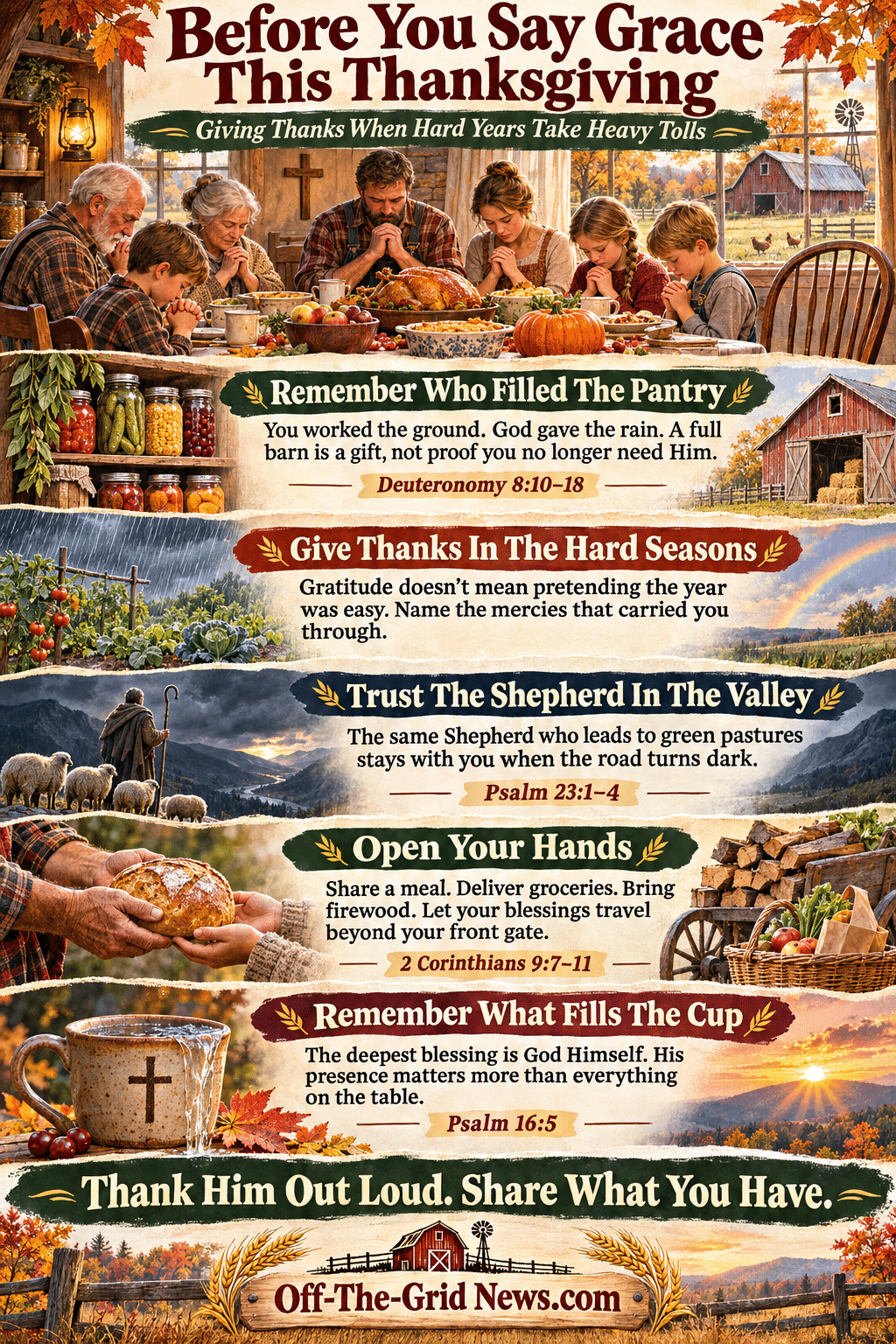
Giving Thanks When Hard Years Take Heavy Tolls
Why A Full Pantry Still Needs A Thankful Heart
You can stack firewood to the rafters, line the cellar with jars, and raise enough potatoes to make the neighbors nervous. But here’s the danger. If all that plenty convinces you that you’ve finally outgrown your need for God, your best harvest has handed you a dangerous dose of false confidence.
That’s the Thanksgiving truth we ought to hear more often in church. A full barn can hide an empty heart. And a dinner table crammed with good food can become the very place where we forget who fed us.
Now, nobody needs another lecture about being vaguely thankful while the gravy gets cold. Thankful to whom? For what? And what does that gratitude look like once the plates are cleared?
So let’s clear away the fog. The Bible gets its boots muddy answering those questions. It takes us into grain fields, through a dark valley, and up to a table where the cup won’t quit overflowing.
Thanksgiving Was Already Old When the Pilgrims Arrived
People were thanking God for food long before anybody carved a turkey in New England. Scripture had already joined worship and harvest together centuries before the Mayflower crossed the Atlantic.
In the fall of 1621, Plymouth’s survivors celebrated their harvest after a brutal first year. Edward Winslow’s eyewitness account describes Massasoit and about ninety Wampanoag men joining a three-day feast; the Wampanoag contributed five deer. They were sharing a harvest feast. The annual national holiday we know today was still a long way off.
Later, George Washington’s 1789 proclamation designated November 26 as a day of public thanksgiving and prayer. He called Americans to recognize God’s care, ask His forgiveness, and seek His help with the work and responsibilities ahead.
Then, with the Civil War tearing families and farms apart, Abraham Lincoln’s October 1863 proclamation invited Americans to observe the last Thursday of November with thanksgiving, repentance, and care for those suffering from the war. That helped establish the November tradition Americans would keep, year after year.
Think about that. A wounded nation was being called to thank God while the wounds were still open. That’s tougher theology than thanking Him because the pie turned out.
God Put Worship Right in the Middle of the Farm Calendar
For starters, open Exodus 23:14–19. God commanded Israel to keep three annual feasts, and the calendar put all three within the rhythm of farm life. First came the Feast of Unleavened Bread, associated with Passover and the spring barley season. Israel ate bread made without yeast and remembered God bringing His people out of Egypt. Freedom, like food, was something they’d received.
Next came the Feast of Harvest, also called the Feast of Weeks. Leviticus 23:15–21 describes a fifty-day count tied to the offering from the first of the harvest. In the New Testament, you’ll hear this feast called Pentecost. Its harvest roots go back before the later Jewish tradition connecting it with the giving of God’s law at Sinai.
Finally came the Feast of Ingathering, also known as the Feast of Booths, or Tabernacles. This came when the year’s produce had been gathered. Deuteronomy 16:13–15 connects it with the threshing floor and winepress. And John 7 places Jesus at that festival in Jerusalem.
So there you have it. Grain, deliverance, gathered crops, worship, and rejoicing belonged in the same conversation. God didn’t ignore the field or treat dinner as an interruption to spiritual life.
Now, let’s get the history straight. Those three feasts didn’t simply turn into the Lord’s Supper and American Thanksgiving. The New Testament identifies Christ as our Passover, and Christian thanksgiving draws deeply from Scripture, but the historical road to our November holiday is more complicated than that. Still, the lesson comes through plain as a dinner bell: remember the Giver when you enjoy His gifts.
Don’t Thank Him With Your Fists Closed
There’s another sentence in Exodus that ought to stop us halfway to the buffet: “None shall appear before me empty.” God was speaking to Israel about the offerings they were to bring when they gathered to worship.
Then Deuteronomy 16:16–17 makes the measure personal. Each man was to give in keeping with what God had given him. Thanksgiving had hands and feet—and something in those hands.
We can learn from that without turning a church offering into an admission charge at God’s door. You can’t buy His kindness, and a poor widow doesn’t become less welcome because a wealthy farmer brings more.
Still, gratitude and a clenched fist make an awkward pair. If God has filled your pantry, who could you feed? If He has given you room at the table, who could you invite? Second Corinthians 9:7–11 joins cheerful giving with God’s provision and the thanksgiving it produces.
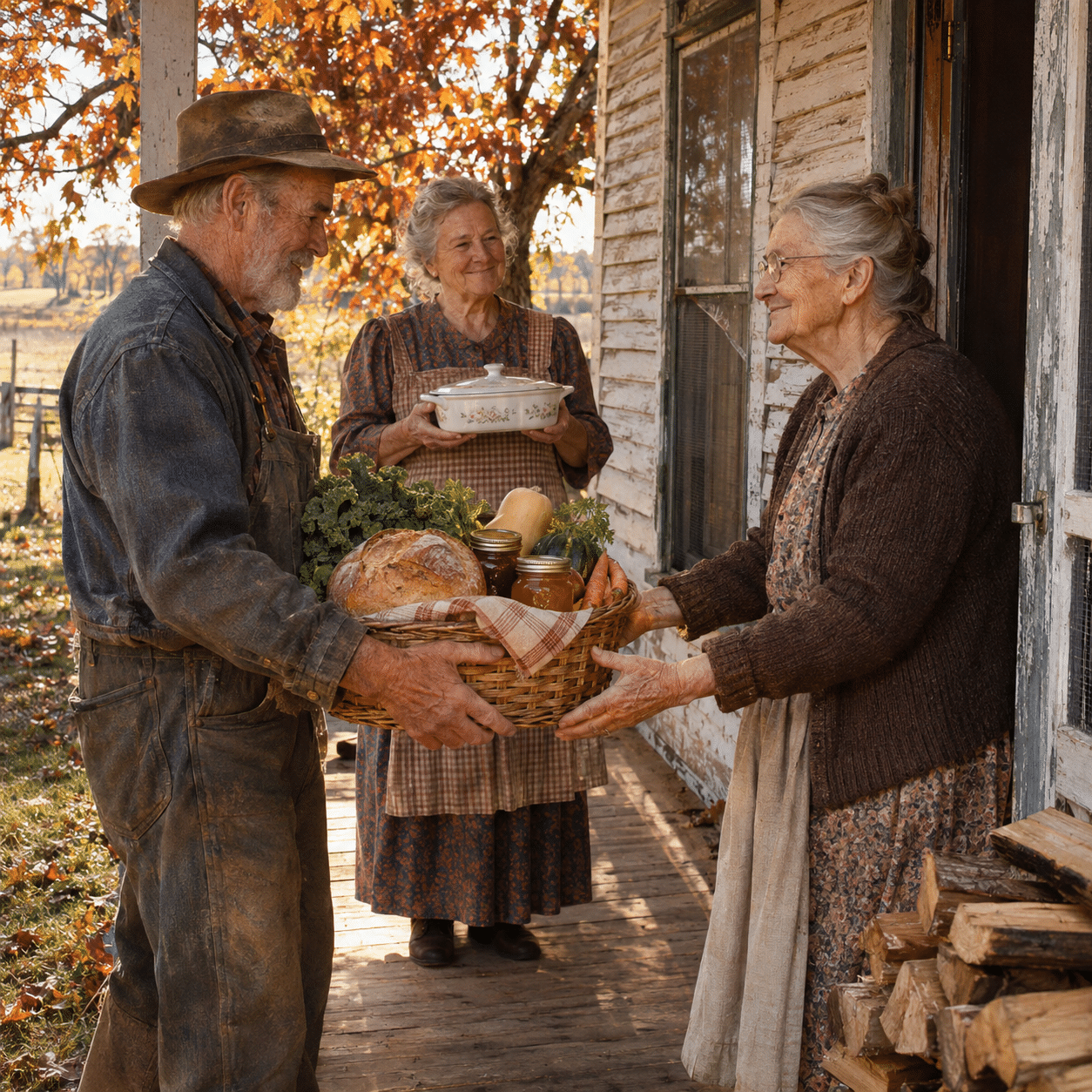
Maybe your gift is a grocery sack on a neighbor’s porch. Maybe it’s firewood for a widow, a meal for somebody who buried a spouse, or help for a family whose paycheck quit before the bills did. Put it this way. If God’s been generous to you, let some of that goodness travel farther than your own front gate.
A Grocery Store Can Hide the Weather From You
Now, modern abundance can play a trick on us. Food arrives washed, wrapped, and stacked under fluorescent lights, and before long we start thinking that’s where it comes from.
But plant a garden and watch how fast that illusion wilts. One hard frost can blacken the beans. One hailstorm can rip through a promising crop before you’ve finished your coffee. Suddenly, those neat rows look like somebody dragged a harrow sideways through them.
Of course, skill matters. Good soil, careful watering, sound judgment, and plain hard work can make a tremendous difference. Scripture doesn’t invite us to neglect the garden and call the weeds an exercise in faith.
Yet even our ability to work is a gift. Deuteronomy 8:10–18 warns people who have eaten well and built good houses against telling themselves that their own strength produced all their wealth.
That warning belongs on the homestead as much as it belongs in a bank lobby. Self-reliance is useful when it means taking responsibility. It turns foolish when you start believing you can provide for every need and control every outcome. You may own the tractor. You still can’t order the rain.
Whoever Feeds You Can Start Giving Orders
But there’s another danger worth facing up to. Whoever controls access to food can gain frightening power over the people who need it.
Look at Genesis 47:13–26. During famine, Egyptians exchanged money, livestock, and eventually land and their own service for food, while Pharaoh’s holdings expanded. There’s plenty to discuss about how Joseph handled that famine. But one thing’s glaringly obvious: desperate hunger can leave people vulnerable, while the person holding the grain gains power.
That ought to make us examine any system that makes ordinary families less able to feed themselves. A government doesn’t become God because it can issue a permit, distribute a benefit, or make a farmer fill out another form.
Meanwhile, the old temptation can grow in our own backyard. We can start trusting a stocked cellar as though it has taken the Lord’s place. A stockpiled pantry makes a fine servant and a miserable savior.
That’s why Jesus taught us to pray, “Give us this day our daily bread”. The man with three months of food needs that prayer just as surely as the man wondering what he’ll eat tonight.
A Full Plate Can Put Your Soul to Sleep
Which brings us to Psalm 23. It’s so familiar that we can recite it while barely hearing a word.
In fact, in his commentary on the psalm, John Calvin warns that prosperity can make people forget God and grow proud. He holds up David as a man who remembered the source of his abundance instead of burying that memory beneath his pleasures.
Of course, we know how that works. A child receives nearly everything on his Christmas list and spends the afternoon grieving over what didn’t arrive. Give us enough years and a checking account, and we can perform the same trick with considerably more expensive complaints. Prosperity can work like novocaine on the soul. Comfort can numb us to the very kindness that ought to wake us up to gratitude.
So David begins where a well-fed person needs to begin: “The LORD is my shepherd; I shall not want.” In plain English, David’s saying he won’t lack what his Shepherd knows he needs. He isn’t saying every wish will show up on the porch.
Here’s the crucial difference. The sheep’s confidence rests in the Shepherd’s care. That’s a sturdier foundation than a good crop, a strong market, or a freezer that hasn’t started making a funny noise.
The Shepherd Knows Which Sheep Keeps Finding the Hole
For a shepherd, this work gets up close and personal. Sheep need feeding, guarding, guiding, and sometimes hauling out of a mess they stumbled into with impressive confidence.
Anybody who’s kept animals knows the type. Fix one opening in the fence and there’s always a volunteer ready to inspect the next one.
Now hear the tenderness in David’s picture. Green pastures. Quiet waters. A restored soul. This Shepherd knows His sheep’s weakness and tends to it rather than standing on the hill shouting advice.
And Jesus makes that care unmistakably personal in John 10:11–15. The good Shepherd knows His own and lays down His life for the sheep.
That takes us far beyond a pleasant country scene. The One who provides for us has given Himself for us. Our gratitude begins to deepen when we remember what His care has cost.
The Same Shepherd Leads Through the Dark Valley
But hold on. Don’t stop reading at the green pasture. David’s next scene takes us through the valley of the shadow of death, and the Shepherd is still there.
Here’s a Thanksgiving truth that deserves more room at the table: God’s care doesn’t come with a promise that every season will be easy. A faithful household can face a ruined harvest, a frightening diagnosis, or an empty chair where somebody dearly loved used to sit.
And when that happens, trembling isn’t proof that God has abandoned you. Nor does every tear prove you’ve failed Him. Scripture gives us faithful people who grieved and cried out; Jesus Himself wept.
When the Scenery Turns Bleak Remember Who Is With You
Still, the valley forces a question we’d rather dodge. Where has our trust been resting? Were we depending on the Shepherd, or mostly on the pleasant scenery?
Now listen to the change in David’s voice. He stops talking about God and starts talking to Him: “Thou art with me.” The pasture may disappear into the dark, but the relationship remains.
His rod and staff comfort David because the Shepherd has both the strength and the care to guard and guide him. Even correction can be mercy when it turns a wandering sheep away from danger.
You don’t have to call the valley pleasant to thank God that He hasn’t left you in it alone.
God Sets the Table While Trouble Is Still Outside
Next, the picture changes from pasture to hospitality. God prepares a table before David in the presence of his enemies, honors him with oil, and fills his cup beyond the brim. Notice where the feast happens. The enemies haven’t necessarily packed up and gone home. God provides while trouble is still within sight.
That hits home when the news is ugly and the bills are piling up on the kitchen counter. Thanksgiving doesn’t require you to pretend the threats are imaginary. It asks you to recognize that your troubles haven’t become the lord of the house.
Then comes that wonderful line: “My cup runneth over.” Think of a cup filled so generously that the contents spill across the rim. That’s David’s picture of abundance. His Host is generous, and His care isn’t about to run dry.
Now, that isn’t permission to waste what somebody else needs. Nor is it a guarantee that every Christian will enjoy David’s royal comforts. It teaches us to relish God’s generosity and remember that what we have is a gift. He doesn’t owe us a life of luxury.
And here’s the best part. There’s something better in that cup than another helping of prosperity. Psalm 16:5 speaks of the Lord Himself as the psalmist’s portion and cup. The deepest blessing is belonging to Him.
Let Your Thanks Travel Beyond the Dinner Table
So when Thanksgiving comes, set the table and enjoy the food. Let the house smell like roasting meat, warm bread, and whatever somebody insists is Grandma’s original recipe, despite three generations of alterations.
Then say grace like you know who you’re talking to. Come right out and name His mercies. Let the children hear something more specific than a hurried thank-you before the serving bowls start moving.
And make room for the hard parts. Thank Him for strength through a rough year, for a neighbor who showed up, for forgiveness you didn’t earn, and for the promise of His presence when the road ahead looks dark.
Afterward, open your hands. Share something. Carry a little of that feast to somebody whose table looks bare.
Your Pantry Can Be Full and You Still Need God
Now, here’s what it comes down to. You can get off the power grid. You’ll never get outside your need for the God who gives you breath, bread, and another morning.
Remember Him when the barn is full. Trust Him when the valley is dark. And when your cup runs over, let somebody else taste the goodness.
That’s Thanksgiving with its boots on.